ALERT! The EARTH Has NEVER BEEN FLAT!
I’m taking a break from the usual animal content for an emergency public service announcement.
It has come to my attention that my children have been taught that fifteenth-century Europeans believed the Earth was flat and Christopher Columbus proved it round.
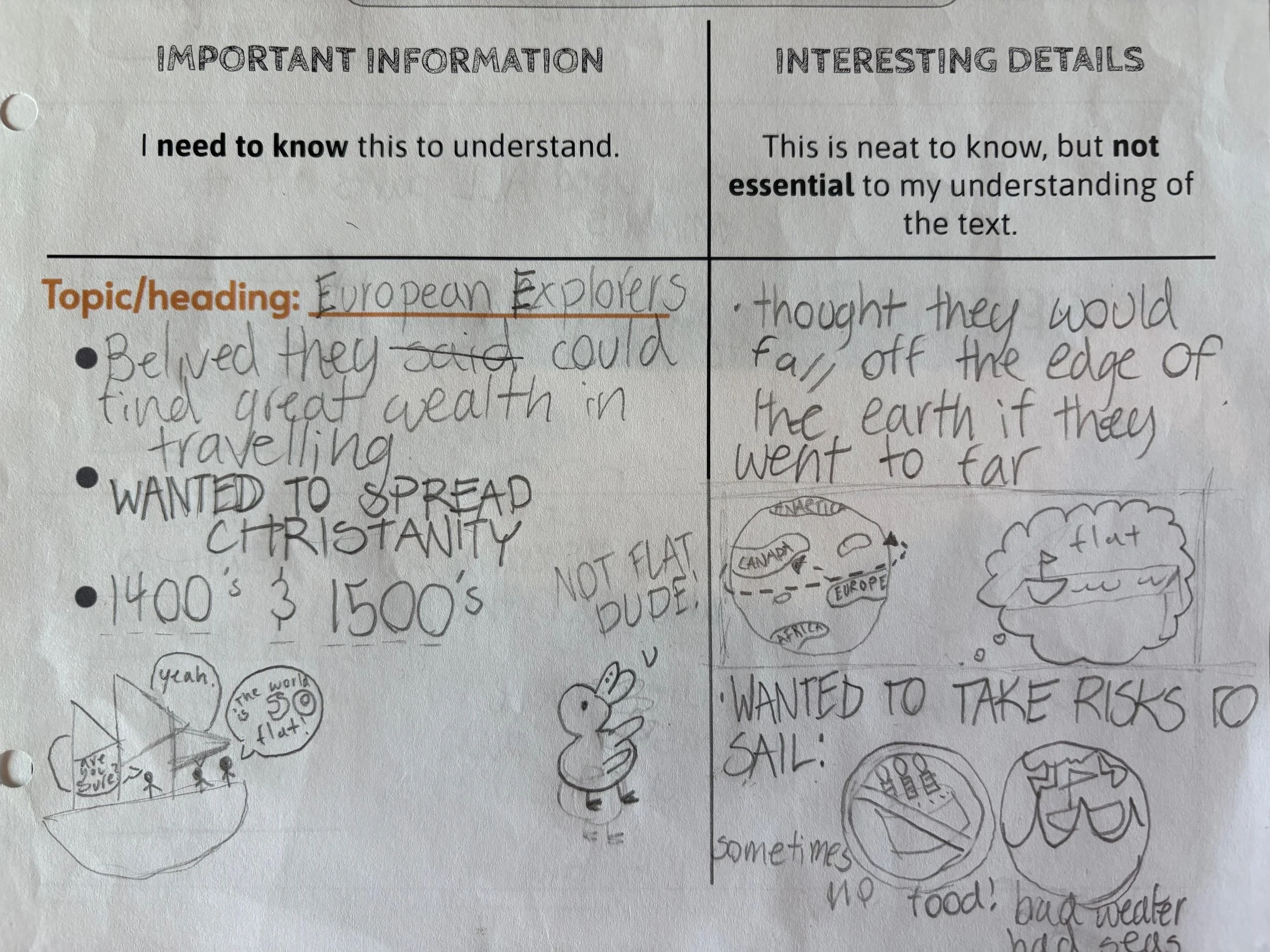
Actual evidence from my daughter’s worksheet.
THIS IS NOT TRUE!
This bizarre falsehood drives me crackers. It’s driven my crackers for decades. So crackers that I’ve just eaten an entire box of crackers just to soothe my nerves.
Let me be very clear. For at least two thousand years, no one in the Western intellectual tradition has ever even suggested the Earth was flat. No one. This is not a thing. The Earth has been spherical for millennia.
Yet my children have just been taught that the first European explorers who travelled west were brave because they feared might fall off the edge of the Earth.
What?!
It is true that Christopher Columbus held different ideas about the Earth’s shape than his contemporaries, but it wasn’t anything about flat versus round. Columbus thought the world was much smaller than the general view, as much as 30% smaller, which would make sailing west from Europe to India, China, the West Indies, and Japan much easier. And guess what? They were right, and Columbus was wrong. The Earth was exactly the shape and size astronomers had long claimed it to be.
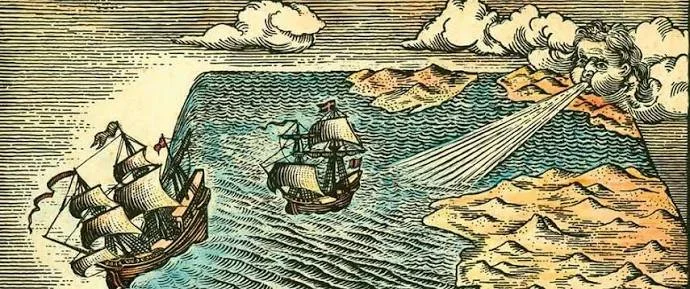
So why does the Flat Earth myth exist?
There’s a couple of reasons, and they have nothing to do with misunderstanding of astronomy or geography. They are about mud slinging.
Have you ever heard of Rip Van Winkle and The Legend of Sleepy Hollow? Their author, Washington Irving, also wrote A History of the Life and Voyages of Christopher Columbus published in 1828. Apparently it was the most popular and most read history of Columbus in the United States, and while it may have contained many factual facts it also set Columbus as a hero and lone believer in a round Earth who fought against European intellectual snobs who said the world was flat. Brave and noble Columbus, herald of a New World, audaciously proved those fusty-crusty Europeans wrong! The story was dramatic and exciting and anti-European and very good for American nationalistic myth-making, but it was wrong. And no one seemed to care.
And then came the evolution debates of the late nineteenth century.
When Charles Darwin published On the Origin of Species in 1859 it obviously caused all sorts of drama in religious and scientific circles. Many people were shocked by his ideas of evolution and his claim that God had not made humans especially but that humans had evolved from other animals. Wondrously bizarre news!
Many intellectuals were inspired to defend Darwin’s work. Naturally, some took to mud slinging. Those fusty-crusty religious zealots who deny evolution are the same sort of fusty-crusty religious zealots who believed the Earth was flat! What a bunch of blinkered losers! This isn’t true! This idea that Christians for some religious reason once believed the Earth was flat is a total myth, an invention of nineteenth-century scientific mud-slinging. But no one seems to care.

I am generally bummed by lazy historical teaching, but my annoyance goes deeper with this one because it completely devalues the accomplishments of ancient astronomers. And this is not okay.
Among my many odd jobs as a student, I was a research assistant to a professor writing a history of ancient belief in extra-terrestrial life. I read many books on ancient astronomy and got to know their general understandings and ideas about the universe. To be honest, I can’t remember a single thing about ancient aliens and whether they existed or not (I think not), but I am remain deeply humbled and emotional affected by the achievements of ancient Greek astronomers.
Let me give you the briefest sampling:
Eratosthenes (c. 276 BC – c. 195/194 BC) stuck a stick in the ground in two different cities at different latitudes at midday on the summer solstice. He measured the difference between the shadows cast by the sticks to be 7.2 degrees or 1/50 of a full circle. Then, using his understanding of angles, he calculated the curvature of the Earth between the two cities. He mathematically combined that measurement with the known distance between the two cities to calculate the Earth’s circumference to be approximately 40,000km. The true circumference of the Earth is 40,075.017 km.
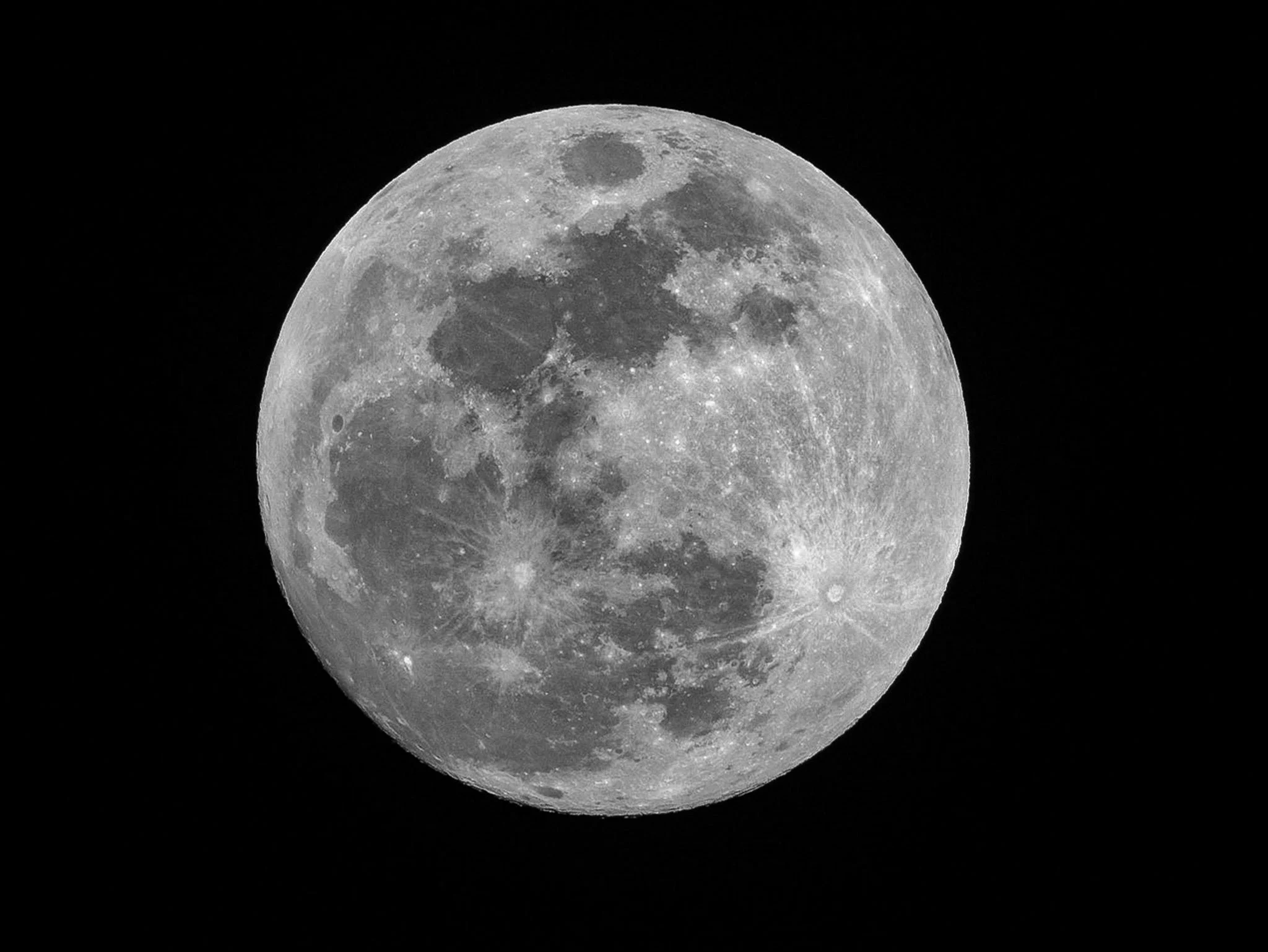
Hipparchus (c. 190 – c. 120 BC) measured how long it took the Moon to pass through the Earth’s shadow during a lunar eclipse. Then using Eratosthenes’s calculation of Earth’s diameter and some fancy trigonometry which he pretty much invented, he calculated the distance between the Earth and the Moon to be about 380,000 km. The real average distance is 384,400 km.
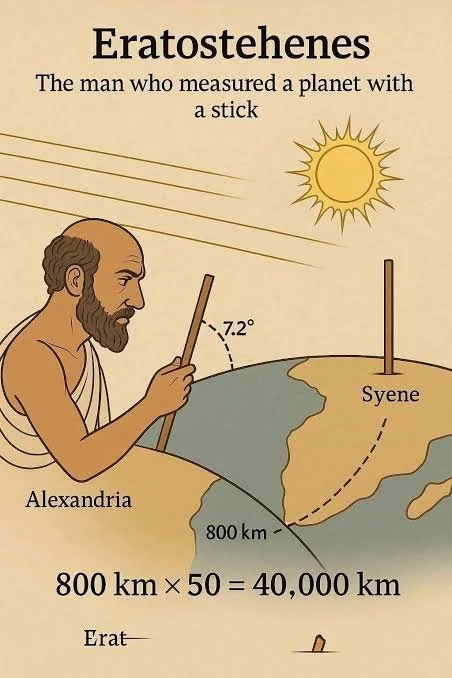
And that’s just two of them. I could go on.
These people accurately measured our universe with sticks and shadows two millennia ago. Simply estimating the distance between two cities on Earth would have been impressive with the tools they had, but without stopwatches or telescopes, they measured the speed of a shadow across the Moon. They invented mathematics to calculate hundreds of thousands of miles of space. I have no words to express my respect for their achievements. And yet my children are taught that everyone before Columbus believed the Earth was flat?? As if everyone before the invention of the Americas were knuckle-draggers? Ugh.
There. I’m done. That’s my annoyance for the day.
But now might be a good time to let you know I’ve written a book about the Moon. Actually, Moon wrote their own autobiography and was lucky enough to have the stupendous Sean Lewis to illustrate it. I will have something to show soon. In the meantime, my favourite starry poem:
When I Heard the Learn’d Astronomer by Walt Whitman
When I heard the learn’d astronomer,
When the proofs, the figures, were ranged in columns before me,
When I was shown the charts and diagrams, to add, divide, and measure them,
When I sitting heard the astronomer where he lectured with much applause in the lecture-room,
How soon unaccountable I became tired and sick,
Till rising and gliding out I wander’d off by myself,
In the mystical moist night-air, and from time to time,
Look’d up in perfect silence at the stars.
Learn more
Dr. Darin Hayton, a historian of science at Haverford College, on the Flat Earth myth: https://www.vaticanobservatory.org/sacred-space-astronomy/washington-irvings-columbus-and-the-flat-earth/
On Eratosthenes’ experiment to calculate Earth’s circumference:
https://trustinscience.com/2025/11/18/when-the-shadow-revealed-the-shape-of-the-world-the-idea-of-eratosthenes/